

Blue Origin’s P-Sampler Launches Aboard JAXA's Martian Moons eXploration Mission
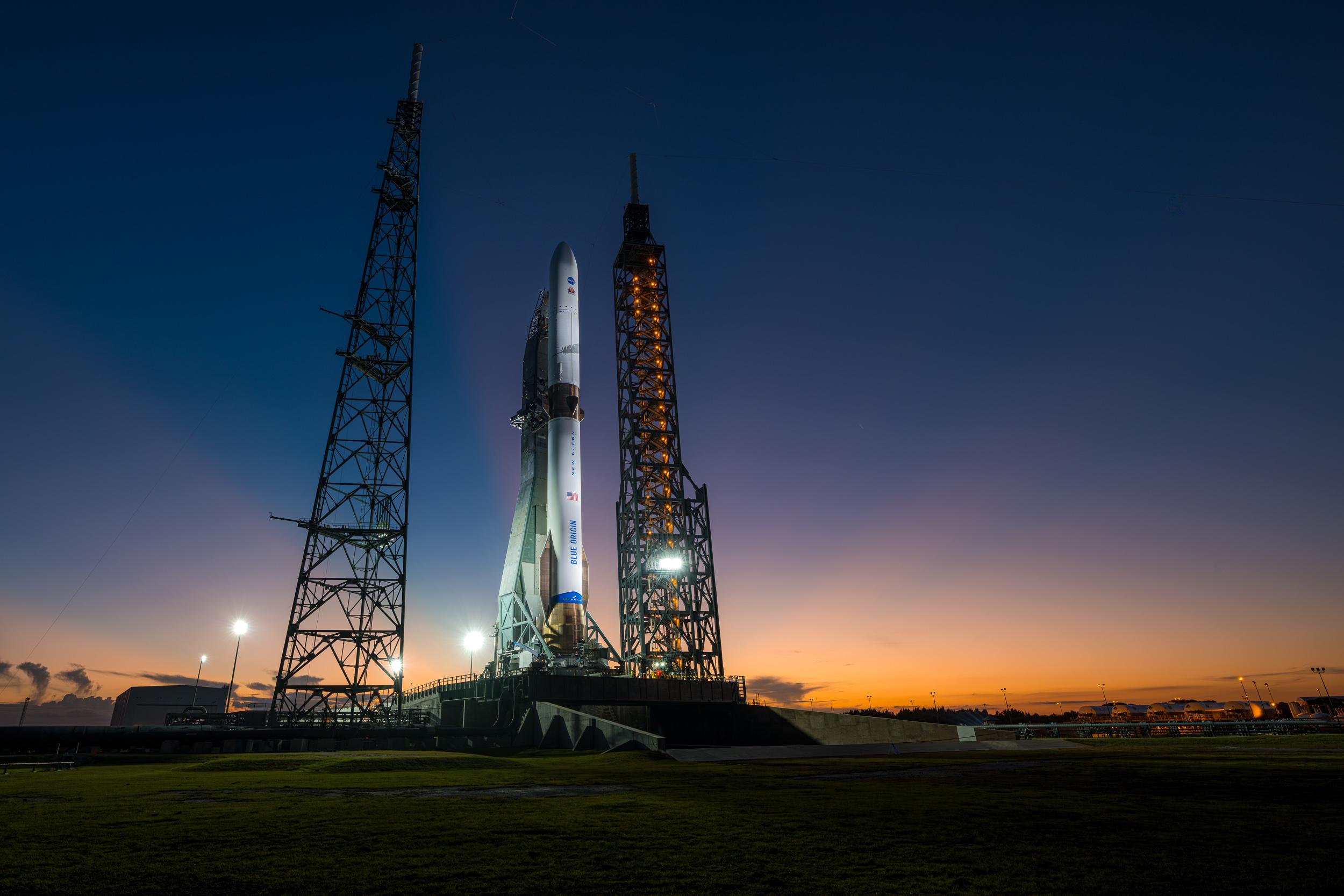
Blue Origin’s Pneumatic Sampler (P-Sampler), a sampling system designed to collect surface material from the Martian moon Phobos, launched today aboard the Japan Aerospace Exploration Agency’s (JAXA) Martian Moons eXploration (MMX) spacecraft from Yoshinobu Launch Complex at the JAXA Tanegashima Space Center. The system, built by Honeybee Robotics, a Blue Origin company, will play a key role in JAXA's effort to return the first-ever samples from a Martian moon to Earth.
MMX is a JAXA-led mission in collaboration with NASA, CNES, and other international partners, aiming to be the first mission to return samples from a Martian moon to Earth. Those samples could help scientists answer long-standing questions about the origins of Phobos and Deimos and offer new insight into the early history of the Mars system.
Collecting surface material from a body like Phobos presents unique engineering challenges. With extremely low gravity, traditional digging or scooping methods don't behave as they would on Earth, the Moon, or even Mars.
To address this, the team designed the P-Sampler to use pressurized nitrogen gas to loosen and lift regolith from the surface into a collection chamber, similar in concept to a reverse vacuum cleaner. This approach allows for efficient sample collection without requiring the spacecraft to anchor or exert significant mechanical force against the surface. P-Sampler sampling head is designed to capture samples while being mounted on a footpad - several inches above the surface.
P-Sampler builds directly on Honeybee Robotics' PlanetVac technology, a pneumatic regolith acquisition system successfully demonstrated on the lunar surface. That flight demonstration validated the core approach of using gas-driven sample collection in a low-gravity, airless environment, providing critical real-world performance data that gave Honeybee's engineers confidence to apply the technology to an even more challenging destination.
The lessons learned on the Earth’s Moon directly informed the design of P-Sampler, enabling Honeybee to adapt the technology for Phobos' unique surface conditions. In this way, P-Sampler represents a natural evolution of Honeybee's work - proving out sampling technology on the Moon, then extending it to new frontiers across the solar system.
"We're proud to see P-Sampler on its way to Phobos," said Kris Zacny, vice president of Exploration Systems at Blue Origin. "This technology builds on decades of sampling expertise, including our PlanetVac demonstration on the Moon. That heritage gave us the confidence to take this next step, and we're excited to see it put to the test in the Martian system."
With launch complete, the spacecraft has begun its journey toward Phobos, where it will eventually carry out sample collection operations using both P-Sampler and a complementary coring tool known as C-Sampler, developed by JAXA. Together, these systems are designed to maximize the mission's chances of successfully acquiring material for return to Earth.
We look forward to following MMX's journey in the years ahead and sharing updates as the mission progresses toward Phobos.
Share
Latest Posts
- Nov 25, 2026
 News
EnduroSat Signs Multi-Launch Agreement with Blue Origin for Dedicated New Glenn Missions for Its Customers
Blue Origin and EnduroSat have signed an agreement for two dedicated launches aboard New Glenn reserved exclusively for EnduroSat customers.
- Nov 19, 2026
 News
Google Selects Blue Origin’s New Glenn for Project Suncatcher
Blue Origin and Google have entered into a launch services agreement for Project Suncatcher.
- Nov 10, 2026
 News
GS1-3 Hotfire Updates
We will continue to provide updates on the hotfire anomaly investigation. Read the latest.